

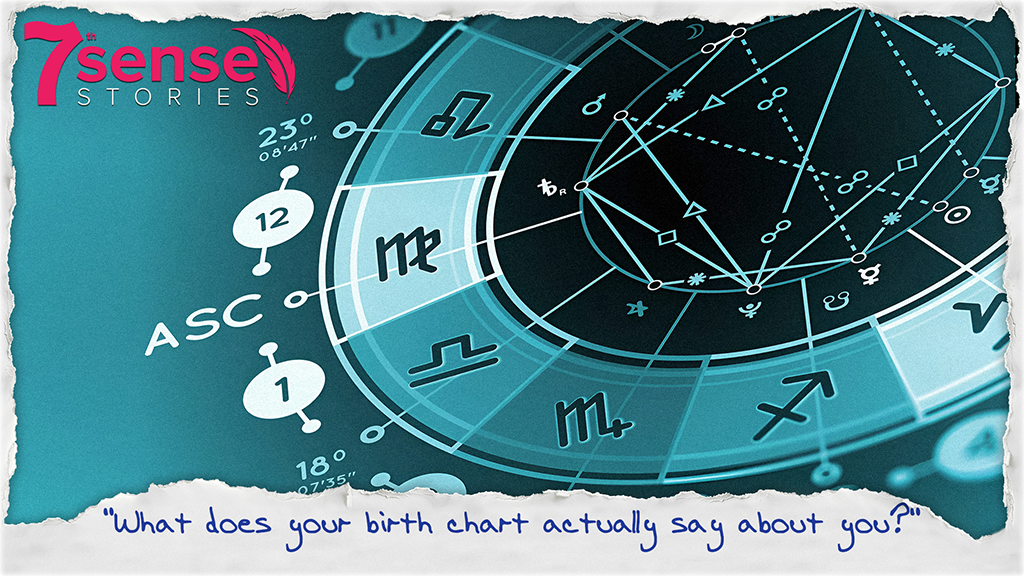
If someone asks you, “What’s your zodiac sign?” you probably know exactly what to say. But if you only know your Sun sign, you’re actually seeing just one small part of your astrological profile.
Your birth chart, also called a natal chart, is a snapshot of the sky at the exact moment you were born. It maps the positions of the Sun, Moon, planets, zodiac signs, houses, and other important points in astrology.
And this is where astrology gets much more interesting.
Your birth chart can be used to explore your personality, emotional patterns, communication style, relationships, ambitions, strengths, challenges, and the areas of life where you may experience the most growth.
So what does your birth chart actually say about you? Let’s break it down.
What Is a Birth Chart?
A birth chart is essentially a personalized map of the sky based on your date, exact time, and place of birth.
Unlike a daily horoscope, which is usually based primarily on your Sun sign, a natal chart takes many different astrological placements into account.
That means two people born under the same zodiac sign can have completely different birth charts.
For example, two Leos might both be confident, expressive, and creative, but one might have a sensitive Cancer Moon while the other has an adventurous Sagittarius Moon. One might have Venus in Virgo and approach relationships cautiously, while the other has Venus in Libra and place a strong emphasis on harmony and partnership.
Your Sun sign might describe one part of you. Your entire birth chart tells a much bigger story.
The Big Three: Sun, Moon, and Rising Sign
If you’re just starting to explore your natal chart, one of the best places to begin is with your Big Three: your Sun sign, Moon sign, and Rising sign.
These three placements can give you a surprisingly useful introduction to your astrological personality.
☀️ Your Sun Sign: Your Core Identity
Your Sun sign is probably the placement you already know.
It represents themes connected to your identity, individuality, self-expression, confidence, and sense of purpose.
This is why people often associate their zodiac sign with their personality.
But your Sun sign isn’t meant to explain everything about you.
Think of it as one of the central characters in your astrological story, rather than the entire story.
🌙 Your Moon Sign: Your Emotional World
Your Moon sign can tell you more about your emotional nature.
It is associated with your instincts, feelings, comfort needs, emotional reactions, and the way you process experiences internally.
This can explain why you sometimes feel very different from the personality people see on the surface.
Someone might have a bold and outgoing Sun sign but a quiet, sensitive Moon sign. Another person might appear calm and reserved while having an emotionally intense Moon placement.
Your Moon can reveal a side of yourself that isn’t always obvious to other people.
🌅 Your Rising Sign: How You Meet the World
Your Rising sign, or Ascendant, is the zodiac sign that was rising on the eastern horizon when you were born.
In astrology, it is connected with your outward personality, first impressions, personal style, and the way you naturally approach new situations.
It also determines the starting point of your astrological houses.
This means your Rising sign can influence much more than simply how other people perceive you.
Your Birth Chart Can Tell You How You Love
Wondering why you behave a certain way in relationships?
Your birth chart can offer plenty of clues.
Astrologers often look at Venus, Mars, the 7th house, and the signs connected to them when exploring romantic relationships.
💕 Venus and Your Love Language
Venus is associated with attraction, affection, pleasure, beauty, values, and relationships.
Your Venus sign can provide insight into what you appreciate in love and what makes you feel valued.
For example, Venus in Leo may enjoy romance, attention, and grand gestures, while Venus in Capricorn may place greater importance on reliability, commitment, and long-term stability.
Neither approach is better.
They’re simply different ways of experiencing affection.
🔥 Mars and Desire
Mars is associated with action, motivation, passion, assertiveness, and desire.
In relationship astrology, Mars can offer insight into how you pursue what you want, express passion, and respond when something really matters to you.
Looking at Venus and Mars together can create a much more nuanced picture of your romantic style than simply knowing your Sun sign.
Your Chart Can Reveal How You Communicate
Ever wondered why some people need to talk through every detail while others prefer to think quietly before saying anything?
Astrology looks to Mercury for clues about communication and thought processes.
Your Mercury sign is associated with how you process information, express ideas, learn, reason, and communicate with other people.
A Mercury in Gemini, for example, may enjoy exchanging ideas, asking questions, and jumping between different topics.
A Mercury in Scorpio may prefer deeper conversations and be more interested in what someone means beneath the surface.
Your Mercury placement can also help explain why you communicate differently from someone who has the same Sun sign as you.
What About Your Career and Life Direction?
Your birth chart isn’t only about personality and relationships.
It can also be used to explore themes around career, ambition, reputation, creativity, and life direction.
Astrologers may pay particular attention to the 10th house, its ruling planet, the Midheaven, Saturn, and other planetary placements when interpreting professional themes.
Your chart might highlight a desire for leadership, creativity, intellectual exploration, stability, service, independence, or public recognition.
That doesn’t mean your birth chart decides what career you have to choose.
Instead, astrology can be viewed as a tool for exploring the kinds of environments and experiences that may feel meaningful to you.
The Houses Show Where Things Happen
This is one of the parts of astrology that can completely change the way you understand a birth chart.
The planets describe what is happening.
The signs describe how that energy is expressed.
The houses show where those themes tend to play out.
There are 12 astrological houses, each traditionally associated with a different area of life.
For example:
- 1st House: identity, appearance, self-expression
- 2nd House: money, possessions, values
- 3rd House: communication, learning, siblings
- 4th House: home, family, roots
- 5th House: creativity, romance, pleasure
- 6th House: routines, work, health, daily life
- 7th House: partnerships and relationships
- 8th House: intimacy, transformation, shared resources
- 9th House: travel, philosophy, higher education
- 10th House: career, reputation, ambitions
- 11th House: friendships, communities, future goals
- 12th House: spirituality, solitude, the subconscious
So, for example, having Venus in your chart is one thing.
Having Venus in your 10th house gives that Venusian energy a completely different area of focus than Venus in the 12th house.
Your Chart Isn’t Just About Your “Good” Traits
One of the most interesting things about astrology is that your birth chart isn’t supposed to be a list of compliments.
Some placements can point toward natural strengths.
Others can highlight internal conflicts, recurring challenges, insecurities, or patterns that require more awareness.
For example, a difficult planetary aspect doesn’t necessarily mean something bad will happen.
It may instead describe an area where you experience tension that encourages growth.
A challenging Saturn placement could feel restrictive at first but eventually encourage discipline and maturity.
An intense Pluto placement might bring themes of transformation and personal power.
A complicated relationship between Venus and Mars could reflect tension between what you want emotionally and what you pursue passionately.
In other words, your chart doesn’t have to be “perfect” to be meaningful.
Sometimes the most challenging parts of a chart are the parts that teach you the most.
What Are Aspects in Astrology?
Once you’ve learned about planets, signs, and houses, there’s another important piece to understand: aspects.
Aspects describe the angles formed between planets in your birth chart.
They show how different parts of your personality and life experience may interact with one another.
Some common aspects include:
Conjunction: Two planets are very close together, combining their energies.
Trine: A harmonious aspect often associated with natural talents and ease.
Sextile: An opportunity-oriented aspect that can support cooperation and development.
Square: A challenging aspect that can create tension and motivate growth.
Opposition: An aspect involving two opposing points, often highlighting a need for balance.
This is one reason birth charts can be so detailed.
You’re not simply looking at individual placements. You’re looking at how the different parts of the chart interact.
Why Your Birth Chart Can Feel Surprisingly Accurate
A detailed birth chart can sometimes feel much more personal than a generic horoscope.
That’s because you’re looking at many different variables at once.
Your Sun sign might describe your identity.
Your Moon sign may describe your emotional needs.
Your Mercury sign can describe your communication style.
Venus can add information about relationships and values.
Mars can reveal how you act and pursue what you want.
Your Rising sign can shape how you approach the world.
The houses place these themes into different areas of life.
And the aspects show how these energies interact.
Together, they create a much more complex picture than simply saying, “I’m a Leo,” “I’m a Scorpio,” or “I’m a Pisces.”
Your Birth Chart Doesn’t Decide Your Future
This is an important distinction.
Astrology is often used for self-reflection and symbolic interpretation. Your birth chart doesn’t mean you’re destined to behave a certain way or experience specific events.
You still make choices.
Your environment matters.
Your experiences matter.
And people can grow and change throughout their lives.
A birth chart can be thought of as a framework for exploring your tendencies and patterns, rather than a fixed script you have to follow.
You might recognize a particular placement immediately.
You might also discover that a placement describes something you have learned to express differently as you’ve grown older.
That’s part of what makes astrology interesting.
How to Read Your Birth Chart for the First Time
If you’re looking at your natal chart for the first time, don’t try to understand everything at once.
Start with these placements:
1. Sun sign: What is your core sense of identity?
2. Moon sign: What do you need emotionally?
3. Rising sign: How do you approach the world?
4. Mercury: How do you think and communicate?
5. Venus: How do you love and what do you value?
6. Mars: How do you act, pursue, and express desire?
7. 7th house: What themes appear in your partnerships?
8. 10th house: What themes appear around career and public life?
Once you understand these basics, you can start exploring the other planets, houses, and aspects.
You don’t need to memorize every astrological symbol before your chart starts making sense.
So, What Does Your Birth Chart Actually Say About You?
Your birth chart doesn’t give you one simple answer.
And that’s exactly why it’s so fascinating.
It can show different sides of your personality that may sometimes seem contradictory. You can be confident and insecure, independent and deeply connected to others, logical and emotional, adventurous and cautious.
You don’t have to fit neatly into one zodiac stereotype.
Your birth chart is a much bigger picture.
The planets, signs, houses, and aspects all contribute different pieces to the story, giving you a more detailed way to explore your personality, relationships, ambitions, emotions, and personal growth.
And perhaps the most interesting part is that your chart isn’t there to tell you who you have to be.
It can simply give you another way to ask:
Who am I, why do I experience things the way I do, and who am I becoming?
That might be where the real magic of astrology begins.
Want To Have A Astrological Psychic Read For You?
One of the tools mostly used with our psychics is the astrological reading. Understanding your sign, your placements and how does the universe also connects with you!
#Astrology #AstrologicalChart #AstrologyChart #SignsPlacement #AstrologicalSigns
(READ: Meet Our Tarot Experts)
Ready for Your Next Psychic Reading?
If you’re looking for clarity about love, career, family, or your personal journey, our experienced psychic readers are available 24/7 to help you explore the questions that matter most.
| Discover the key to renewal and balance this fall with a Fall Renewal Psychic Reading from 7th Sense Psychics. Whether you’re ready to release the past, restore emotional clarity, or find fresh direction for the season ahead, our compassionate readers are here to guide you. Experience personal renewal through spiritual insight and supportive guidance—book your Fall Renewal Psychic Reading today and step confidently into your next chapter. | |
|
|

Comments are closed.